
Blog
What Does HGH Do to Women? The Complete Evidence-Based Guide
Mar
Human growth hormone sparks intense curiosity among women seeking answers about energy, body composition, and aging. If you are asking what does HGH do to women, you likely want to know whether this hormone offers genuine benefits—and what risks accompany its use.
The answer is complex. HGH plays vital roles in female metabolism, muscle maintenance, and even reproductive function. However, the effects differ dramatically between women with diagnosed growth hormone deficiency and healthy women seeking anti-aging or performance benefits. This comprehensive guide explains everything you need to know: how HGH naturally functions in the female body, the evidence-backed benefits, the significant risks, and the critical importance of medical supervision.
Disclaimer: The information below is for educational and informational purposes only. HGH is a prescription medication available only for FDA-approved indications. This content does not constitute medical advice or encourage off-label use. Always consult with a licensed healthcare professional before considering any hormone therapy. For legitimate medical guidance, visit www.realinstoreclinic.com.
What Is HGH and How Does It Work in Women?
Before answering what does HGH do to women, you need to understand the hormone itself.
Natural Production and Function
Human growth hormone is a peptide hormone produced by the pituitary gland—a pea-sized structure at the base of the brain . It releases in short pulses, primarily during deep sleep and after exercise. Once released, HGH signals the liver and other tissues to produce insulin-like growth factor-1 (IGF-1), which mediates many of its effects on protein synthesis, muscle maintenance, and fat metabolism .
HGH serves several essential functions throughout a woman’s life:
- Muscle maintenance: Promotes protein synthesis and preserves lean mass
- Fat metabolism: Enhances lipolysis—the breakdown of stored fat for energy
- Tissue repair: Supports recovery from exercise and injury
- Collagen production: Influences skin elasticity and connective tissue health
- Bone density: Helps maintain skeletal strength
The Natural Decline with Age
After puberty, the pituitary gland gradually produces less growth hormone. For most women, this natural decline manifests as :
- Increased body fat, particularly around the abdomen
- Reduced muscle mass and tone
- Slower recovery from exercise
- Decreased energy levels
- Thinner skin and reduced collagen
These age-related changes drive interest in HGH supplementation. However, experts strongly caution that the natural decline in HGH differs fundamentally from true growth hormone deficiency .
What Does HGH Do for Women? Key Effects Explained
When exploring what does HGH do to women, the effects fall into several categories: metabolic, musculoskeletal, reproductive, and aesthetic.
1. Effects on Body Composition and Metabolism
HGH significantly influences how women store and burn fat.
Lipolysis and Fat Burning: HGH enhances the breakdown of stored fat (lipolysis), shifting the body toward using fatty acids for energy—particularly during sleep and exercise . This metabolic shift helps preserve lean muscle mass during caloric restriction.
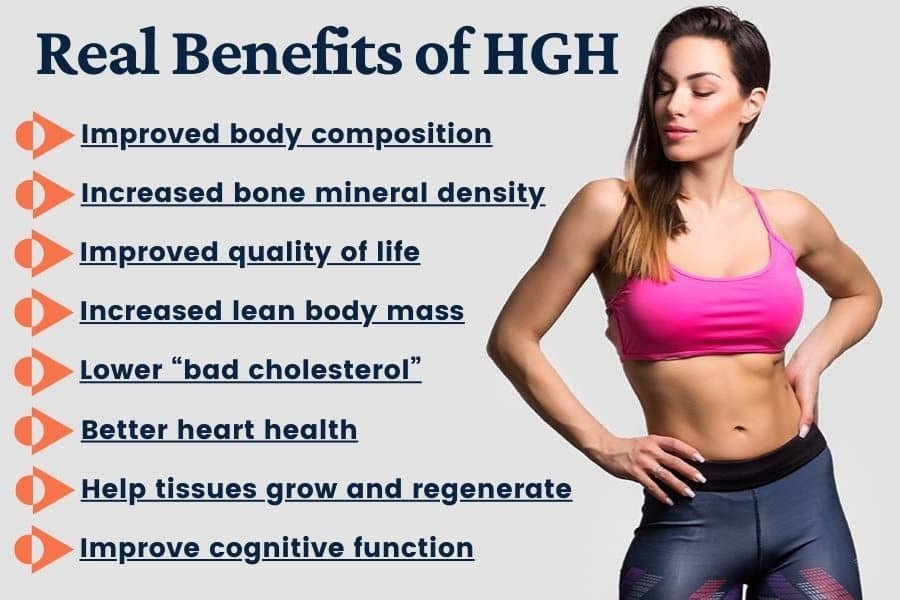
Lean Mass Preservation: By stimulating IGF-1 and protein production, HGH helps maintain lean body mass during dieting . For women with growth hormone deficiency, studies show that GH replacement therapy increases lean body mass by an average of 2.61 kg while reducing fat mass by 2.19 kg .
The Reality Check: For healthy women without deficiency, the effects are far less dramatic. Research shows that while HGH can increase lean body mass in healthy older adults, the gain in muscle does not necessarily lead to gains in strength . Weight change remains minimal unless sleep, diet, and training are optimized .
2. Effects on Muscle Tone and Recovery
HGH plays a crucial role in exercise recovery and muscle maintenance.
Enhanced Recovery: By stimulating tissue repair, HGH helps women recover faster from workouts. This cumulative effect—combined with quality sleep, consistent training, and adequate protein—contributes to improved muscle tone over time .
Exercise Capacity: Some research suggests HGH may improve anaerobic performance and sprint capacity . However, other studies show no improvement in strength or exercise capacity, and some indicate HGH may actually reduce exercise performance .
3. Effects on Skin, Hair, and Anti-Aging
Many women ask what does HGH do to women specifically regarding appearance and aging.
Collagen and Skin Elasticity: HGH influences collagen turnover and tissue hydration . Women receiving HGH therapy sometimes report:
- Improved skin elasticity and texture
- Softer fine lines
- Firmer-feeling skin
Hair Quality: Some women notice enhanced hair quality over time with sustained therapy .
The Important Caveat: These changes are typically subtle and accumulate over months with consistent treatment, proper nutrition, and overall health habits. HGH does not reverse aging or extend lifespan . A landmark meta-analysis of 18 randomized controlled trials concluded that HGH could not be recommended for anti-aging purposes due to the increased rate of adverse events .
4. Effects on Reproductive Function and Fertility
This area represents one of the most clinically significant answers to what does HGH do to women.
Ovarian Function: GH receptors are expressed in adult human ovaries, and HGH plays direct roles in ovarian steroidogenesis and ovarian angiogenesis . The hormone promotes the development of ovarian cells and enhances the metabolism and proliferation of endometrial cells .
Fertility Treatment: In assisted reproductive technologies, HGH has shown benefits for specific populations. Research indicates HGH may benefit women with :
- Poor ovarian response to stimulation
- Low ovarian reserve
- Advanced maternal age (38+)
- Previously poor embryo quality
Studies suggest HGH administration can produce :
- More oocytes (eggs) retrieved
- Improved egg quality
- Better embryo quality
- Higher pregnancy success rates
Puberty and Sexual Function: HGH modulates the timing of puberty and influences female sexual function . Women with growth hormone deficiency often report improvements in sexual function after receiving GH replacement therapy .
The Caution: The authors of a 2021 NIH-published review caution that “there is little direct experimental evidence of its function in the human ovary” and that “the evidence and biological plausibility for a direct action in the normal patient remains to be established” .
5. Effects on Mood and Quality of Life
GH replacement therapy has been shown to improve mood and quality of life in women with growth hormone deficiency . Female gender is associated with more marked improvements in quality of life scores after treatment, particularly among women with low baseline QoL scores .
However, these benefits apply specifically to women with diagnosed deficiency—not healthy women seeking enhancement.
HGH Injections vs. Supplements: What Women Need to Know
When researching what does HGH do to women, you will encounter both prescription injections and over-the-counter “HGH supplements.”
Prescription HGH Injections
What they are: Recombinant human growth hormone (rhGH), identical to the hormone your pituitary produces .
Administration: Subcutaneous injection, typically daily.
Availability: Prescription only, for FDA-approved indications (growth hormone deficiency, HIV/AIDS wasting, certain pediatric conditions) .
Effectiveness: Proven for growth hormone deficiency; directly raises IGF-1 levels with predictable effects on body composition, metabolism, and quality of life .
Safety: Requires medical supervision, dosing based on lab results, and ongoing monitoring.
HGH Supplements and Secretagogues
What they are: Over-the-counter products containing amino acids, melatonin, or herbal ingredients claimed to boost natural HGH production .
Administration: Oral pills or sprays.
Availability: No prescription required.
Effectiveness: Very limited. These products rarely contain actual HGH. Their impact depends entirely on fundamentals: quality sleep, adequate protein, resistance training, and stress control .
Safety: Unregulated; products may contain undeclared ingredients. Caution is warranted because many supplements contain ingredients that might stimulate endogenous GH production in unpredictable ways .
The Bottom Line
No pill form of HGH exists for therapeutic use . Legitimate HGH therapy always involves injectable medication prescribed by a licensed healthcare provider. If a product claims to contain oral HGH, it either contains no HGH or is illegal.
HGH Side Effects in Women: What You Must Know
Understanding what does HGH do to women requires equal attention to risks and benefits.
Common Side Effects
The most frequent side effects involve fluid and glucose metabolism .
Metabolic Effects
HGH therapy can affect glucose metabolism :
- Increased fasting glucose and insulin levels
- Impaired insulin sensitivity
- Potential development of diabetes in susceptible individuals
Women who are obese or have a family history of type 2 diabetes face particular vulnerability to these effects and should closely monitor glucose status during therapy . In one randomized controlled trial, diabetes appeared in 4% of subjects and carbohydrate intolerance in 20% after 12 months of GH therapy .
Long-Term Concerns
Several long-term risks require consideration :
- Acromegaly: Excessive HGH can cause abnormal growth of hands, feet, and facial features
- Cardiovascular effects: GH treatment increases levels of Lp(a), a risk factor for atherosclerosis
- Cancer risk: Theoretical concern about IGF-1 promoting certain malignancies; HGH is contraindicated in patients with active cancer
Who Should NOT Use HGH
HGH is contraindicated in women who :
- Are pregnant or breastfeeding (information on safety lacking)
- Have active malignancy
- Have proliferative diabetic retinopathy
- Have hypersensitivity to HGH components
The Importance of Medical Supervision
All side effects are manageable under proper medical care. The key is starting with low doses, titrating gradually, and maintaining regular monitoring . Never resort to gray-market medications or self-prescribe .
What HGH Does NOT Do: Managing Expectations
When asking what does HGH do to women, understanding limitations is as important as understanding benefits.
HGH Does NOT:
- Replace the need for proper nutrition and exercise. Benefits depend on sleep, diet, and training as foundational elements .
- Dramatically reverse aging or extend lifespan. The FDA explicitly advises against using HGH for anti-aging, and research shows no life extension benefit .
- Produce rapid, steroid-like muscle gains. Effects develop over months, not days. In healthy individuals, muscle mass increases slightly but strength gains are not guaranteed .
- Work effectively without adequate sleep and stress management. HGH releases primarily during deep sleep; poor sleep undermines any therapy .
- Provide benefits without potential side effects. Even with medical supervision, side effects occur and require management.
The Research Reality
For women with adult growth hormone deficiency, clinical studies demonstrate favorable outcomes: fat mass reduction, lean mass increase, exercise tolerance improvement, and quality of life enhancement—typically occurring over months .
For healthy women without deficiency, the evidence tells a different story. A meta-analysis of 44 studies evaluating GH effects on athletic performance found that athletic performance was not improved by HGH supplementation . While lean body tissue increased, it likely reflected fluid retention rather than true muscle growth .
The Estrogen Connection: Why HGH Affects Women Differently
Estrogen significantly impacts HGH sensitivity and dosing requirements—a crucial consideration when asking what does HGH do to women.
Oral vs. Transdermal Estrogen
- Oral estrogen therapy reduces IGF-1 production because it passes through the liver first. Women taking oral estrogen typically need higher HGH doses to achieve therapeutic effects .
- Transdermal estrogen (patches, gels) does not have this effect. Women using non-oral estrogen may not require dose adjustments .
This interaction explains why HGH dosing must be individualized based on a woman’s complete hormone profile. Always discuss estrogen replacement or oral contraceptives with your healthcare provider when considering GH therapy .
HGH for Women: The Medical Evaluation Process
For women with suspected growth hormone deficiency, the path to therapy involves rigorous evaluation.
What Proper Medical Evaluation Includes
- Comprehensive health history: Symptoms, medical conditions, medications, other hormone concerns
- Physical examination: Assessment of body composition, signs of deficiency or excess
- Laboratory testing: IGF-1 levels; stimulation tests if adult GH deficiency suspected
- Baseline assessment: Blood pressure, fasting glucose, lipid profile
- Diagnosis confirmation: True growth hormone deficiency must be documented
Starting Doses for Women
Medscape’s clinical guidelines for growth hormone deficiency in adults provide specific dosing recommendations based on age and estrogen status :
| Patient Category | Recommended Starting Dose |
|---|---|
| Women on oral estrogen therapy | 0.4-0.5 mg/day |
| Age 30-60 years | 0.2-0.3 mg/day |
| Age >60 years | 0.1-0.2 mg/day |
Ongoing Monitoring Requirements
Once HGH therapy begins, proper care requires :
- Regular follow-up every 1-2 months during dose titration
- Dose adjustments based on IGF-1 levels and clinical response
- Monitoring of fasting glucose, hemoglobin A1C, and lipid profile
- Assessment of side effects (fluid retention, joint pain)
- Quality of life questionnaires to evaluate benefits
Natural Ways to Support HGH Levels
Before considering pharmaceutical HGH, women can optimize natural production through lifestyle strategies.
Sleep Optimization
HGH releases primarily during deep sleep. Strategies include:
- Aim for 7-9 hours of quality sleep
- Maintain consistent sleep-wake times
- Create a dark, cool sleeping environment
- Avoid screens before bedtime
Exercise Strategies
High-intensity exercise stimulates HGH release:
- Resistance training (weightlifting)
- High-intensity interval training (HIIT)
- Adequate recovery between sessions
- Consistency over time
Nutrition
Proper nutrition supports natural HGH production:
- Adequate protein intake
- Balanced meals with healthy fats
- Avoiding high-sugar meals before sleep
- Staying hydrated
Stress Management
Chronic stress elevates cortisol, which suppresses HGH:
- Meditation or mindfulness practices
- Regular physical activity
- Adequate rest and recovery
- Social connection
For many women, optimizing these lifestyle factors produces meaningful improvements in energy, body composition, and well-being—without the risks of pharmaceutical HGH.
Frequently Asked Questions
What does HGH do to women’s bodies?
HGH influences multiple systems: it enhances fat breakdown, preserves lean muscle, supports tissue repair, influences collagen production for skin health, and plays roles in ovarian function and fertility . Effects vary dramatically based on whether a woman has growth hormone deficiency.
What does HGH do to women’s skin?
HGH influences collagen turnover and tissue hydration. Women receiving HGH therapy often report improved skin elasticity, softer fine lines, and firmer-feeling skin. These changes accumulate over months with consistent treatment and proper overall health habits .
What does HGH do to women’s fertility?
HGH modulates ovarian steroidogenesis, promotes ovarian cell development, and enhances endometrial cell metabolism . In assisted reproduction, HGH may benefit women with poor ovarian response, low ovarian reserve, or advanced maternal age .
What does HGH do to women’s weight?
HGH enhances lipolysis—the breakdown of stored fat for energy . For women with growth hormone deficiency, studies show significant fat mass reduction with therapy. For healthy women, effects are minimal unless combined with proper nutrition and exercise .
What does HGH do to women’s mood?
GH replacement therapy improves mood and quality of life in women with growth hormone deficiency. Female gender is associated with more marked improvements in quality of life scores after treatment .
What does HGH do to women if they take too much?
Excessive HGH can cause acromegaly—abnormal growth of hands, feet, and facial features. It can also worsen insulin resistance, increase cardiovascular risk, and raise Lp(a) levels associated with atherosclerosis .
What does HGH do to women during pregnancy?
HGH is contraindicated during pregnancy. Information regarding safety and efficacy in pregnancy is lacking . Women should avoid HGH use when pregnant or breastfeeding.
What does HGH do to women compared to men?
Women metabolize and respond to growth hormone differently than men, primarily due to estrogen interactions. Oral estrogen reduces IGF-1 production, often requiring higher HGH doses in women. Transdermal estrogen does not have this effect .
Internal Resource: RealInstoreClinic
For women seeking legitimate medical guidance on hormone health, www.realinstoreclinic.com provides access to licensed healthcare professionals.
Services Offered
RealInstoreClinic specializes in:
- Comprehensive hormone evaluations
- Evidence-based hormone therapy when medically indicated
- Ongoing monitoring and dose management
- Patient education and support
Why Choose RealInstoreClinic
Unlike unregulated online sources, RealInstoreClinic:
- Operates with licensed healthcare providers
- Requires proper medical evaluation
- Issues valid prescriptions only when clinically indicated
- Provides ongoing monitoring for safety
- Protects your health through evidence-based care
Getting Started
Visit www.realinstoreclinic.com to:
- Schedule a consultation with licensed healthcare providers
- Discuss your health goals and concerns
- Understand whether hormone evaluation is appropriate for you
- Access legitimate, supervised care
Conclusion: The Bottom Line on HGH for Women
The question what does HGH do to women yields a nuanced answer that depends entirely on context.
For women with diagnosed growth hormone deficiency, HGH therapy offers proven benefits:
- Reduced fat mass and increased lean body mass
- Improved exercise capacity and recovery
- Enhanced quality of life and mood
- Better bone density
- Potential fertility benefits when indicated
For healthy women without deficiency, the evidence tells a different story:
- HGH does not reverse aging or extend lifespan
- Athletic performance does not improve with supplementation
- Weight changes are minimal without lifestyle optimization
- Side effects—including fluid retention, joint pain, and glucose intolerance—are common
For all women considering HGH, one principle holds true: medical supervision is non-negotiable. Proper evaluation, prescription requirements, and ongoing monitoring protect your health and ensure that any therapy aligns with your actual medical needs.
The pursuit of health and vitality is admirable. Start with the foundations: quality sleep, resistance training, balanced nutrition, and stress management. These evidence-based approaches improve well-being without pharmaceutical risks.
If you have concerns about energy, body composition, or overall health, consult a licensed healthcare provider. Visit www.realinstoreclinic.com to schedule a proper evaluation and explore evidence-based treatment options.
